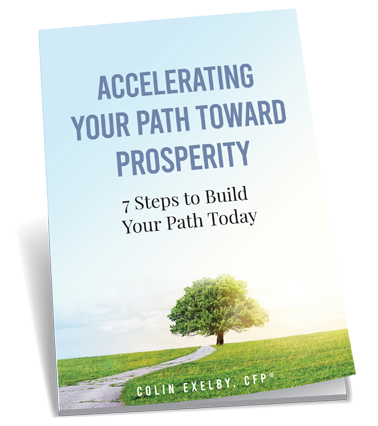

After years of working with retirees, I’ve found Roth conversions are often discussed in overly simplistic terms. This Roth Conversion Timing Guide explains how retirement-focused Roth conversion planning may impact taxes, Medicare premiums, Social Security taxation, required minimum distributions, and long-term retirement flexibility.
Some people believe everyone should do them. Others believe they are never worth it because taxes are due immediately.
In reality, Roth conversions are neither automatically good nor automatically bad. The key variable is usually timing.
A well-timed Roth conversion can reduce lifetime taxes, lower future required minimum distributions, create more flexible retirement income, and improve long-term planning for a surviving spouse or heirs.
A poorly timed Roth conversion can trigger unnecessary taxes, increase Medicare premiums, or move income into a higher tax bracket without enough long-term benefit.
This guide explains how to think about Roth conversion timing the way a retirement planner does.






A Roth conversion is the process of moving money from a pre-tax retirement account such as a Traditional IRA or old 401(k) into a Roth IRA.
Because pre-tax accounts were funded with deductible contributions or tax-deferred growth, the converted amount is generally taxable as ordinary income in the year of conversion.
Benefits may include:
The real question is usually not whether Roth conversions are possible. It is whether paying taxes now may create better long-term outcomes later.


The same $100,000 conversion can produce very different results depending on:
That is why Roth conversion planning is often about identifying the right window of opportunity.


For many retirees, the years after retirement but before Social Security and required minimum distributions fully begin may create unusually low taxable income years.
For some households, these may be the lowest-tax years of their adult life.
That period can become a strategic Roth Conversion Window.
Reasons may include:
Those years can create opportunities to convert portions of IRA assets at lower tax rates than later in retirement.

There is no universal conversion amount.
Many retirees choose to convert only enough each year to:
For many households, partial multi-year conversions may be more efficient than one large conversion.


IRMAA stands for Income-Related Monthly Adjustment Amount.
Higher taxable income can increase Medicare Part B and
Part D premiums.
Because Roth conversions increase taxable income in the year of the conversion, it may trigger higher future medicare premiums based on income in that year.
This does not automatically mean conversions are bad. In fact, it can mean the opposite.
Paying higher premiums in a single year or a few years of conversions can result in decades of lower future Medicare premiums because of the permanent reduction in RMD income.
Current and future Medicare costs should be evaluated as part of the decision.
Traditional IRA beneficiaries may inherit taxable accounts that must generally be distributed over time under current rules.
Roth IRA beneficiaries may inherit assets with more tax flexibility.
For some families, selective Roth conversions may improve long-term after-tax outcomes across generations.

I rarely begin with “Should we convert?”
I usually begin with:
Then we determine whether Roth conversions improve the broader retirement plan.
Sometimes the answer is yes. Sometimes partially yes. Sometimes no.
The right answer is household-specific.

If you want to be the first to know when it’s ready,
Click the button below.
There is no universal best age. Many opportunities occur after retirement but before Social Security and RMDs begin.
They can. Higher taxable income may trigger IRMAA surcharges.
Some households benefit from partial multi-year conversions. Others should not convert at all.
Generally yes. Converted pre-tax dollars are usually taxable as ordinary income.
Often outside taxable funds preserve more Roth value, but it depends on liquidity, age, and tax situation.
Yes. Reducing traditional IRA balances may reduce future required minimum distributions.
Sometimes yes. Widow/widower tax brackets may become less favorable later.
Roth conversions are often less about the conversion itself and more about understanding when paying taxes now may improve flexibility later.
For many retirees, the Roth conversion itself is simple.
The real value often comes from choosing the right years to do it.
By Colin Exelby, CFP®
Founder, Celestial Wealth Management
Below are additional Roth IRA and Roth 401(k) strategy videos that expand on key
topics such as conversion mistakes, 5-Year Rules, taxation, and the future of Roth IRAs.
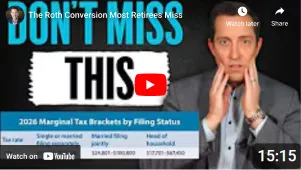
The Roth Conversion Most
Retirees Miss

Why the Roth Is the Most Powerful Tool for Tax-Free Retirement Income
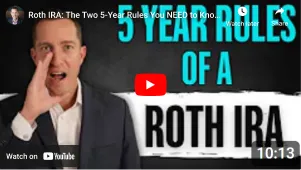
Roth IRA: The Two 5-Year Rules You NEED to Know (Don’t Lose Your Money!)

Can the Government Tax Your Roth IRA in the Future?
Disclosures: The opinions voiced in this material are for general information only and are not intended to provide specific advice or recommendations for any individual.
We suggest that you discuss your specific situation with a qualified financial or tax advisor.Advisory Services offered through Celestial Wealth Management, LLC, a registered investment advisor.
Built to help you make more informed decisions about Social Security, tax planning, and retirement income. Join the list to be notified when it becomes available.
Celestial Wealth Management has adopted this privacy policy with recognition that protecting the privacy and security of the personal information we obtain about our customers is an important responsibility. We also know that you expect us to service you in an accurate and efficient manner. To do so, we must collect and maintain certain personal information about you. Federal law also requires us to tell you how we collect, share, and protect your personal information. Please read this notice carefully to understand what we do.
Through this policy and its underlying procedures, Celestial Wealth Management attempts to secure the confidentiality of customer records and information and protect against anticipated threats or hazards to the security or integrity of current and former clients’ records and information. We want you to know what information we collect and how we use and safeguard that information.
We collect certain nonpublic information about you (“Customer Information”). The
essential purpose for collecting Customer Information is to allow us to provide advisory services to you. The types of personal information we collect and share depend on the product or service you have with us. This information can include:
We restrict access to your nonpublic personal information to those employees who need to know that information to provide products or services in furtherance of the client’s engagement with Celestial Wealth Management. We maintain physical, electronic and procedural safeguards that comply with applicable federal or state standards to protect your nonpublic personal information.
We collect your personal information, for example when you
We may disclose the client’s information for our everyday business purposes:
We are permitted by law to disclose the nonpublic personal information about you to governmental agencies and other third parties in certain circumstances (such as third parties that perform administrative or marketing services on our behalf or for joint marketing programs). These third parties are prohibited to use or share the information for any other purpose. Celestial Wealth Management only authorizes employees who have signed a copy of the Privacy Policy to have access to client information. Employees violating Celestial Wealth Management’s Privacy Policy will be subject to our disciplinary process. In the event there were to be a material change to our privacy policy regarding how we use your confidential information, we will provide written notice to you. Where applicable, you would be given an opportunity to limit or opt-out of such disclosure arrangements.
If you have questions about this privacy notice or about the privacy of your customer information call (443) 438-7211 or visit http://www.celestialwm.com and ask to speak to the Chief Compliance Officer
Built to help you make more informed decisions about Social Security, tax planning, and retirement income. Join the list to be notified when it becomes available.
If you are trying to find the path toward keeping more of what you make, increasing your net worth and build a legacy don’t miss out.